


.png)
From Beauty School to Med Spa: Career Paths for Ambitious Estheticians

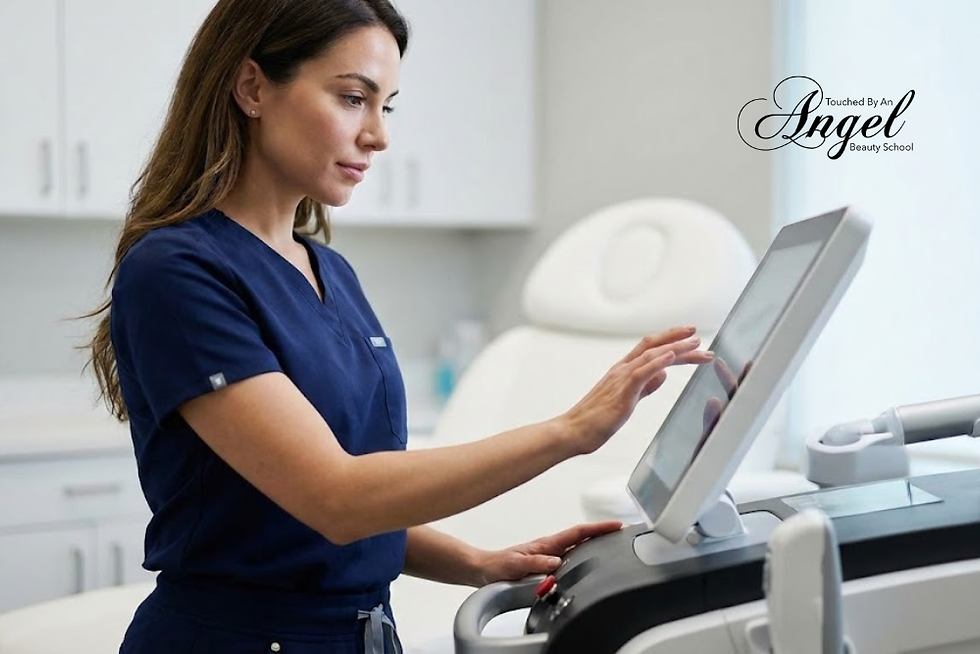
When most people picture an esthetician at work, they imagine serene day spas with cucumber slices and relaxing facials. And sure, that's part of the industry. But there's another side that doesn't get talked about nearly enough: medical estheticians working alongside dermatologists and plastic surgeons, operating laser equipment, and helping patients recover from advanced cosmetic procedures.
The medical spa industry has exploded in recent years, with over 10,000 locations now operating across the United States. That growth has created career opportunities that didn't exist a decade ago. If you're considering esthetics as a profession, or you're already in school and wondering where this path might lead, the med spa world is worth understanding.
Here's what you actually need to know about making that transition, from the training requirements to the salary differences to what the day-to-day work really looks like.
What Does a Medical Esthetician Actually Do?
Medical estheticians perform advanced skincare treatments in clinical settings, assist physicians with procedures, provide pre- and post-operative care, and educate patients about treatment options and recovery protocols.
The daily work in a med spa looks pretty different from a traditional spa environment. You're performing treatments like chemical peels, microdermabrasion, laser hair removal, and microneedling, procedures that require a deeper understanding of skin physiology and stricter safety guidelines. You're also conducting detailed skin analyses with clinical-grade equipment, the kind of stuff you won't find at your neighbourhood day spa.
One of the biggest differences? You're working under physician supervision. That means a dermatologist or plastic surgeon oversees the practice, and you have access to medical-grade products and equipment that aren't available in retail spa settings. Your patient population changes, too. You'll see people managing medical skin conditions, recovering from procedures, or dealing with scarring and hyperpigmentation that go beyond typical cosmetic concerns.
The collaboration aspect is something a lot of estheticians find rewarding. You're part of a healthcare team, working alongside nurses, physician assistants, and doctors. You might see a patient for lymphatic drainage massage sessions following a body contouring procedure like a custom waist-shaping procedure, helping reduce swelling and support their recovery over several weeks.
There's more documentation involved. Charting, patient notes, treatment records. It feels more clinical because it is more clinical. But here's something people don't always realize: medical estheticians often become the "face" of the practice for returning patients. You build long-term relationships in a way that traditional spas (where clients get shuffled between whoever's available) don't always allow.
How Much More Can Medical Estheticians Earn?
Let's talk money, because the pay difference is real. According to the Bureau of Labor Statistics, skincare specialists working in physician offices earn significantly more than those in traditional spa settings.
Personal Care Services (Day Spas)Median hourly wage: $18.55Top 10% annual wage: N/AKey difference: Primarily tip-based pay
Physician's Office (Med Spas)Median hourly wage: $23.40Top 10% annual wage: Exceeds $77,330Key difference: 26% higher base pay
That 26% wage premium adds up over a career. Medical settings also tend to offer commission on higher-margin medical-grade skincare lines, and some provide actual benefits packages—health insurance and paid time off—that day spas rarely match.
Geography matters too. Washington, D.C., and New York tend to be the highest-paying markets. Medical settings often have more predictable schedules—fewer evening and weekend shifts, as med spas typically operate during regular office hours.
What Training Do You Need Beyond Basic Esthetics School?
Licensed estheticians need their state credential (1,000 hours in Georgia) plus specialized training in medical protocols, advanced modalities like lasers, and ideally national certification through organizations like NCEA.
1. Build a Strong Foundation
Don't underestimate how much quality training matters. It's genuinely harder to unlearn bad habits than to learn correctly from the start. Pay attention in your anatomy and skin science courses—that knowledge becomes your base for everything in medical esthetics. Programs like the Esthetics Program at Touched By An Angel Beauty School emphasise both technique and skin science fundamentals that translate directly to clinical settings.
2. Earn Your State Credential
In Georgia, licensure requires 1,000 hours of esthetics training at a board-approved school, followed by written and practical state board exams. This is your non-negotiable starting point—everything else builds from here.
3. Bridge to Medical Esthetics
Once licensed, additional training will enable you to enter the med spa field. Many employers provide on-the-job training for their specific equipment. Device manufacturers often offer free or employer-paid certification programs. Some states require separate certification for laser and light-based treatments, so check your state's requirements.
4. Consider National Certification
The National Coalition of Estheticians Association (NCEA) offers the leading national certification, evaluating skills at the 1,200-hour level—above what most state licensure requires. Some states recognise NCEA credentials for advanced or master esthetician licensure, and it signals to employers that you're serious about the profession.
5. Keep Learning
Georgia requires 5 CE hours every two years, with at least 3 in health and safety. But in medical esthetics, ongoing learning isn't just a requirement—it's survival. New technologies emerge constantly, and med spa employers often pay for advanced training because they need staff who can keep up.
Why Is the Med Spa Industry Growing So Fast?
The medical spa industry grew from 8,899 to over 10,488 locations between 2022 and 2023, now exceeding $17 billion annually, driven by demand for non-invasive cosmetic procedures and an ageing population.
According to the American Med Spa Association's 2024 Industry Report, the industry has added over 30,000 jobs in the past three years. Medical spa locations jumped from 8,899 in 2022 to 10,488 in 2023. The industry now exceeds $17 billion and is growing by about $1 billion per year.
What's driving all this? A few things are happening at once. Non-invasive cosmetic treatments have become more socially acceptable across all demographics. Social media has increased awareness about appearance in ways that weren't true even ten years ago. The ageing population wants preventative and corrective treatments. And men, the fastest-growing demographic in medical aesthetics, are increasingly seeking skincare and aesthetic services.
The Bureau of Labour Statistics projects employment for skincare specialists to grow 7% from 2024 to 2034, which is much faster than average for all occupations. That translates to about 14,500 job openings projected annually. The growth reflects both increased demand for services and a shift toward skincare specialists rather than generalist cosmetologists.
Something interesting is happening too: the line between "wellness" and "medical" is blurring. Med spas now offer services like IV therapy, hormone optimisation, and weight management alongside traditional aesthetic treatments. That creates even more career pathways for estheticians who pursue additional training and are willing to expand their skill sets.
How Do You Actually Land a Med Spa Job?
Landing a med spa position requires building a strong portfolio during training, networking with medical professionals, targeting dermatology offices for entry-level experience, and demonstrating clinical professionalism in interviews.
1. Start Building Your Foundation Now
Even if you're still in school, med spa employers notice graduates who come from rigorous programs. Choosing a program that emphasises both technique and professionalism, like those offered at TBA Beauty School, gives you a stronger starting point than rushing through a bare-minimum program.
2. Document Your Work
While you're training, before and after photos (with client permission) become your portfolio. Volunteer for advanced technique demonstrations when your school offers them. Ask questions. Show initiative. These things get remembered.
3. Consider Stepping-Stone Positions
Your first job doesn't need to be at a med spa. Dermatology offices often hire new graduates for basic esthetics services: facials, skin prep, and patient education. High-end day spas that carry medical-grade product lines can bridge the gap. Plastic surgery recovery centres need estheticians for post-operative skincare. Don't dismiss positions with "assistant" or "trainee" in the title—they're foot-in-the-door opportunities.
4. Know What Hiring Managers Want
When you interview at med spas, they're looking for a clinical mindset: attention to detail, documentation skills, and almost obsessive hygiene practices. They want someone comfortable discussing medical topics and anatomy. Professional presentation matters more than in casual spa settings—this is a medical environment. Show willingness to learn new technologies and protocols. Soft skills count too: patient communication, managing expectations, and showing empathy during someone's recovery process.
5. Network Strategically
Networking helps more than people realise. Attend medical aesthetics conferences and trade shows if you can. Device manufacturer reps often know who's hiring before positions are publicly posted. Shadow medical estheticians, if anyone will let you. Join professional organisations like ASCP or NCEA. The connections matter.
Is Medical Esthetics Right for You?
Medical esthetics suits detail-oriented estheticians who enjoy clinical environments, continuous learning, patient education, and working as part of a healthcare team rather than independently.
Not everyone belongs in a med spa, and that's completely fine. It might be a great fit if you're fascinated by skin science and anatomy, not just the artistic side of beauty. If you prefer structured environments with clear protocols. If you're comfortable with medical terminology and genuinely want to keep learning throughout your career. If you enjoy educating patients, not just performing services. If you want career growth opportunities and higher earning potential.
But other paths might suit you better if you love the creative, artistic freedom of makeup and styling. If you prefer building your own business as an independent contractor. If medical environments feel too clinical or impersonal to you. If you thrive on variety and dislike repetitive tasks. If the idea of ongoing training and certification feels like a burden rather than an opportunity.
Here's the thing though: it's not all or nothing. Many estheticians work part-time in both settings, especially early in their careers. Skills transfer between environments. You can always transition later once you know more about what you actually enjoy doing day-to-day. The beauty of this industry is that there are multiple paths forward.
Building Your Path Forward
Medical esthetics represents one of the most exciting and well-compensated directions you can take as a licensed esthetician. The industry's growth shows no signs of slowing down, and the opportunities keep expanding. The path from beauty school to med spa is absolutely achievable. It takes solid foundational training, some strategic career moves, and a commitment to ongoing education.
Start now, even if you're still early in your journey. Pay attention in your anatomy and skin science courses. Build relationships with instructors who have medical aesthetics experience. Research med spas in your area to understand what they're looking for in candidates. Talk to medical estheticians if you can find any willing to share their experience.
Whether you're just starting to explore esthetics or you're ready to take the next step toward licensure, the right training program makes all the difference. If you're in the Atlanta area and want to learn more about building a career in skincare, the team at Touched By An Angel Beauty School can help you understand your options and create a path forward. Great careers start with solid foundations, and the med spa world is waiting for estheticians ready to grow into it.


Comments